
A video about the pattern of waves making up the wake of a ship or a duck. This is a common topic in university-level fluid mechanics courses, but my intention was to give a fairly complete explanation without assuming any more advanced knowledge than trigonometry.
Full Video
Edited transcript with video snippets
A duck swimming on a calm body of water leaves a pattern of waves in its wake. A very similar wake occurs behind small boats and giant ships.
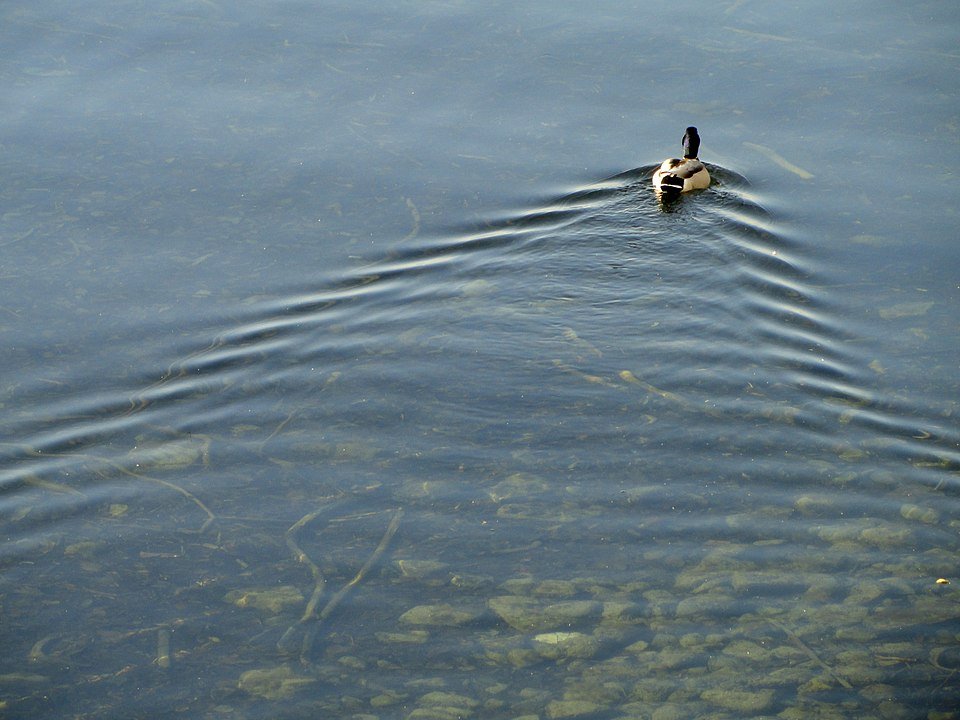
The wake is a V consisting of feathery waves. Inside of it we see fainter parallel crests following the duck.
Surprisingly, the angle of the V is the same for all these vessels and waterfowl. It always will be, as long as a few simple assumptions are satisfied. To explain why, we need to know a little about the nature of water waves.
Before we consider moving ships or ducks, let’s have a look at waves produced by a disturbance at one place and one instant in time. For example, if we throw a pebble into the water. After the initial mayhem in the centre has died down, we see circular waves propagating outwards.
Looking closely, we see that these waves aren’t as simple as we could have expected. On the outside the waves seem to have a longer wavelength: the crests are further apart than on the inside.
In other words, the longer waves have travelled faster.
When looking at waves in a pond, or in almost any real-life example of water waves, we see a mixture of wavelengths. If we could separate them out into perfect waves of one particular wavelength each, the picture would look like this.
Long waves move more quickly than the short ones. It turns out that, in deep water, the speed of a wave is proportional to the square root of its wavelength. This dependence of wave speed on wavelength can be mathematically derived from a suitable mathematical model of water waves, but we will just take it as an experimental fact and move on.
Sine waves
Waves of a pure wavelength are often called sine waves because their shape is described by a sine function
$$ \sin(k x) . $$
The constant \(k\), called the wave number, determines the wavelength: the sine function will give the same value if \(kx\) increases by 360° (or \(2 \pi\) if you prefer radians), i.e. if \(x\) increases by \(\frac{360^\circ}{k}\). This means that the wave repeats itself every time we move a distance of \(\frac{360^\circ}{k}\). This distance is the wavelength, denoted by the Greek letter lambda:
$$ \lambda = \frac{360^\circ}{k} . $$
In particular, a bigger value of \(k\) leads to shorter waves.
If we change the argument of the sine function by some number \(a\), the whole profile shifts. If this number increases in time, we get a moving wave. Writing the number \(a\) as \(\omega t\), where \(\omega\) (Greek letter omega) is a constant and \(t\) is time, we get the formula for a moving wave.
$$ \sin(k x – \omega t) $$
The constant \(\omega\) is called the angular frequency of the wave, or simply the frequency. To determine the speed of the wave, we look for values of \(x\) and \(t\) (space and time) such that the argument of the sine function remains constant, let’s say equal to zero. This is the case if
$$\frac{x}{t} = \frac{\omega}{k} . $$
In this formula, \(\frac{x}{t}\) (position over time) is the wave’s velocity, so we find a formula for the wave’s velocity:
$$ v = \frac{\omega}{k} . $$
Let’s put our observation about the wave speed of deep water waves into this language. The speed equals \(\frac{\omega}{k}\) and is proportional to the square root of the wavelength:
$$ \frac{\omega}{k} \sim \sqrt{\lambda} . $$
But the wavelength itself is proportional to \(\frac{1}{k}\). Putting this together reveals that omega must be proportional to the square root of the wave number \(k\):
$$ \frac{\omega}{k} \sim \sqrt{\frac{1}{k}} \qquad \Rightarrow \qquad \omega \sim \sqrt{k} . $$
Group velocity
Let’s have another look at the circular waves. Unlike the sine waves we just saw, the crests are not moving with the same speed as the waves as a whole. Crests seem to appear at the back of the group, then overtake the group and disappear at the front.
The speed of the individual crests is called the phase velocity and the speed of the group as a whole is called the group velocity. They are different because the wave we’re looking at is not a single sine wave, but a superposition of many of them
The best way to understand how this happens is to look at the superposition of only two sine waves, with wave numbers that are almost the same, but not exactly. Let’s call them \(k\) and \(\bar k\). Superposition means taking the sum of the two waves. In some places their crests overlap to sum to a wave twice the size. In other places a crest of one wave coincides with the trough of the other and their sum will be very small.
We see that individual wave crests move faster than the large features of the white wave. There are two different speeds associated with this combined wave. To find out what those two speeds are, we need a bit of trigonometry.
We’re dealing with the sum of sine functions. Using a sum-to-product identity, we can turn this into a product of a sine and a cosine:
$$ \sin(k x – \omega t) + \sin(\bar k x – \bar \omega t)
= 2 \sin\!\left( \frac{k + \bar k}{2} x – \frac{\omega + \bar \omega}{2} \right) \cos\!\left(\frac{k – \bar k}{2} – \frac{\omega – \bar \omega}{2} t \right) $$
The point of this calculation is that we’ve now written the superposition as a product of two waves. The first one is described by a sine function and has a wave number and frequency very close to the \(k\)s and \(\omega\)s of the two waves we combined. The second one is described by a cosine instead of a sine, but that in itself doesn’t really change much. However, its wave number and frequency however are quite different. We learned that the speed can be calculated by dividing the frequency by the wave number, so the speed of the cosine wave is given by
$$ \frac{\omega – \bar \omega}{k – \bar k} . $$
Now we start to understand the combined wave. It consists of a wave with about the same properties as the two waves we started with, multiplied with an additional wave with different properties. The first wave (blue) still determines the speed of the wave crests, called phase velocity. But the second wave (yellow) wave determines the group velocity, the speed at which the larger wave packets move.
For those of you who know calculus, there is a more enlightening way to write the group velocity. So far we’ve written the speed of the cosine wave as a fraction. You may recognize this fraction from the definition of a derivative. If \(k\) and \(\bar k\) are close to each other, it will be a very good approximation of the derivative of \(\omega\) with respect to \(k\). By this argument, the group velocity of a wave packet is given by \(\frac{\text{d} \omega}{\text{d} k}\).
Earlier we learned that, for deep water waves, the frequency \(\omega\) is proportional to \(\sqrt k \), say \(\omega = \alpha \sqrt{k} \) for some constant \(\alpha\). Using this, we can derive that the group velocity is exactly half of the phase velocity:
$$ v_{\text{group}} = \frac{\text{d} \omega}{\text{d} k}
= \frac{\text{d}}{\text{d} k} \alpha \sqrt k
= \frac{\alpha}{2 \sqrt{k}}
= \frac{\omega}{2 k}
= \frac{1}{2} v . $$
This is a key result for deep water waves: wave packets move at half the speed of individual wave crests. Group velocity is half the phase velocity.
Ducks
Now we are ready to talk about the wakes of cargo ships and sailing yachts. Or ducks!
Let’s start by looking at a single point in the wake of the duck. Since not all waves travel at the same speed, the waves that we observe at this one point in the wake originated at many points along the duck’s past trajectory. So the disturbance we observe is the sum of many contributing waves, a few of which are illustrated here.
For each contribution we draw an arrow at the point where it originated. This illustrates that every point along the trajectory contributes a little something to the observed wave. Some contributions are upwards and some downwards Often they mostly cancel each other out, but this depends on where we take our observation. For some observation locations, a large section of the trajectory will contribute in the same direction. In these places we observe a disturbance in the water surface. In other words, we see a wave whose height is represented by the white arrow.
To get a picture of the wake of the duck we repeat this exercise for many points in the water. This time we don’t draw the individual contributions of
points on the trajectory, only the observed wave heights. As the grid gets finer, we start to recognize the V-shaped wake.
Since the arrows indicate the height of the water, we may as well do away with arrows and plot the surface of the water.
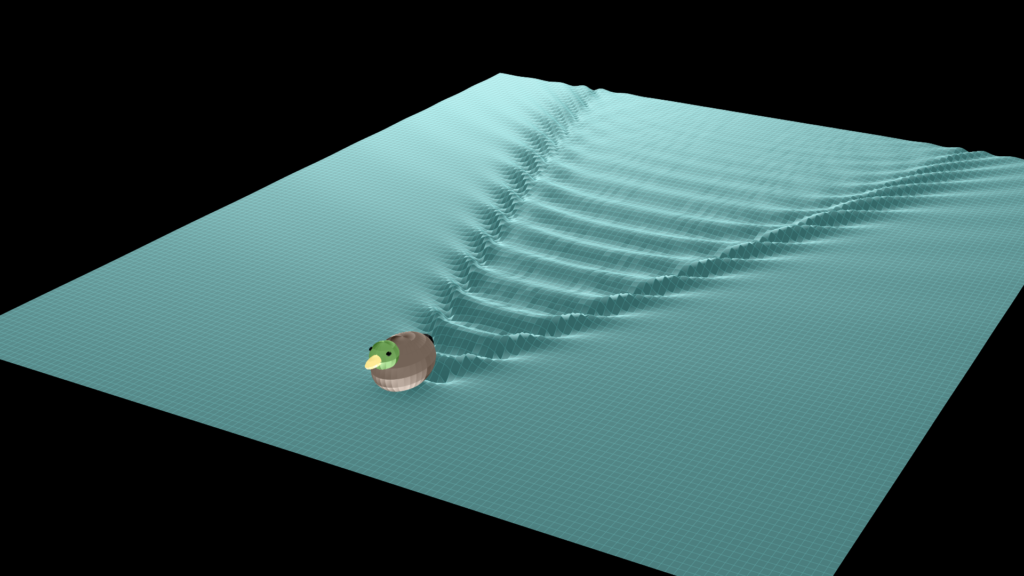
This looks very much like a real wake!
But why is the wake confined to this V shape? And why is the shape the same for a duck and for a ship? To explain this, we need one more simplifying assumption. We assume that the wake pattern is stationary from the perspective of the duck. This is supported by observations: the wake of a ship always seems to be moving with it as if it were attached to the ship.
With this assumption, let’s go back to the individual contributions from the past trajectory of the duck. Which of these waves are stationary?
One stationary wave would be the wave moving in the same direction as the duck with a wavelength that gives it exactly the same speed. But this isn’t the only one. Waves going at an angle can also appear stationary from the perspective of the duck. The duck always sees the first crest of this wave at the same angle, indicated by the white line. The wave doesn’t appear to be stationary because it gets further and further away, But if we consider similar waves produced at later times, their combined wave front is perfectly stationary from the duck’s point of view.
The bigger the angle between the direction of the wave and the duck’s trajectory, the slower it must travel to be stationary from the duck’s point of view. Interestingly, the points reached by stationary waves originating at the same point will lie on a circle. This can be deduced from the fact that the waves all propagate perpendicular to the duck’s line of sight.
But wait! This circle goes far beyond the V-shaped wake we see… This is because to determine if a wave is stationary we use the phase velocity, but to figure out where the wave packet will be after some time, we need the group velocity. As we found out earlier, for deep water waves this is exactly half the phase velocity. So the stationary contributions from this one point in the past do not lie on the big circle but on the bright yellow one half its size. From the duck’s point of view, this circle lies within a fairly small angle determined by the white line tangent to the circle. With a bit of trigonometry we can determine that this angle is about 19.5 degrees.
Great! But if we draw a V at this angle on the duck’s wake, we see that the wave pattern goes slightly beyond it…
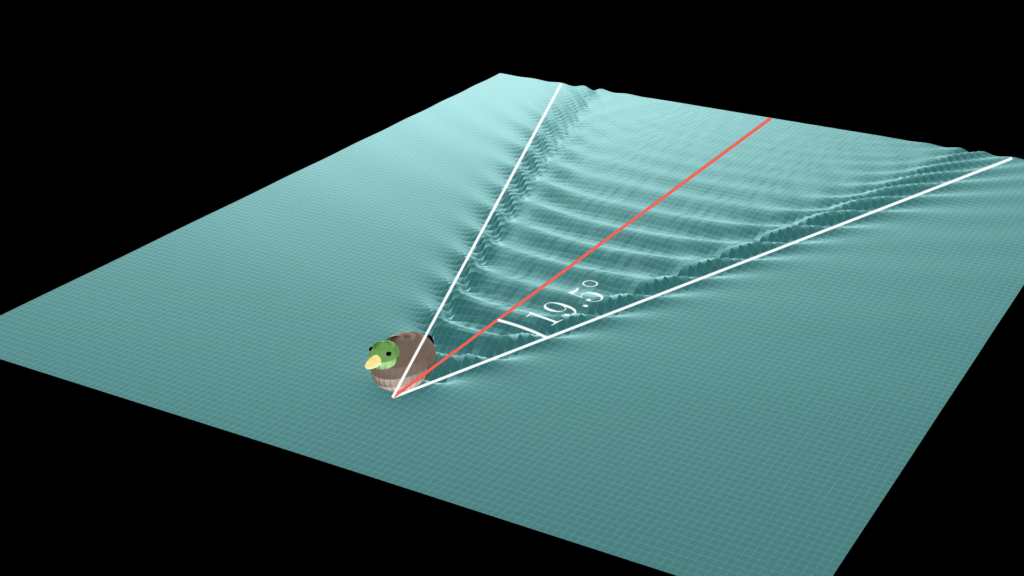
This is because we have made some simplifying assumptions. Most notably we thought of the individual waves as perfectly localized with a precisely defined speed. That’s an unrealistic idealisation.
In practice waves will always affect at least a small area around the points where we imagine them to be, which is why the disturbance we see here reaches slightly beyond the angle we calculated. With this caveat, and with the assumptions that water is sufficiently deep and the moving object relatively slow, the angle of about 19.5 degrees is universal.
You can check this for yourself, for example by hunting around google maps for ships with a clearly visible wake, and measuring the angle.
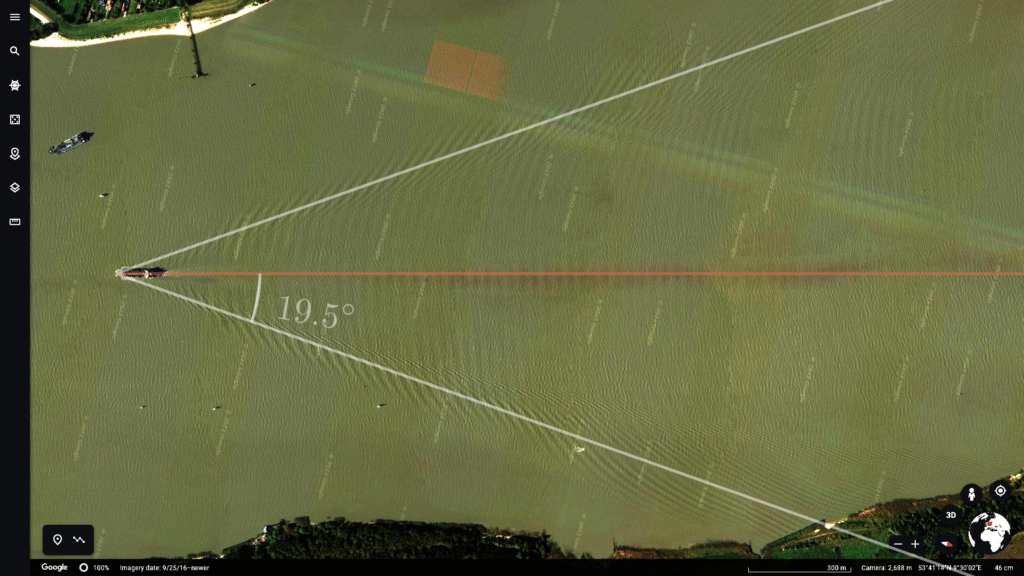
Or you could go outside and ponder the waves on a pond or a lake.
YouTube video published on 2 September 2022
This page was updated 30 July 2026
The content of this page can be reused with attribution under the CC BY 4.0 license.